
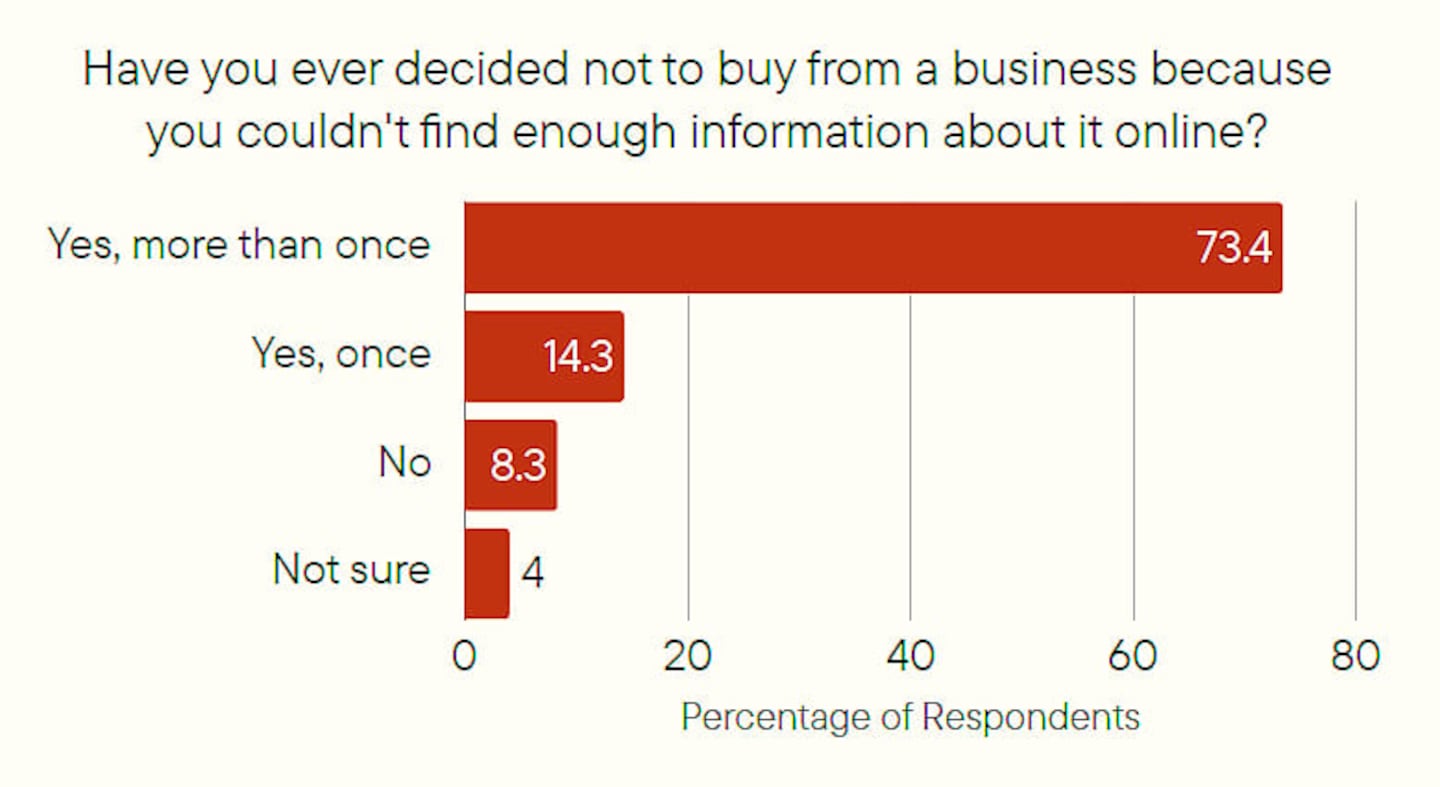
Nearly every adult has hesitated before an online purchase because they doubted the business's legitimacy. A new TrustedFirms.io survey of 1,146 U.S. adults conducted in September 2026 found that 97.1% admitted that they have worried that a business they found online might not be real. Additionally, 87.7% of respondents said they have decided not to hire or buy from a business because they couldn't find enough information about it online.
TrustedFirms.io
That caution is understandable. The FTC logged 3 million fraud reports in 2025, up from 2.6 million in 2024.
Today, research is crucial, whether you're hiring a service provider or buying a product. TrustedFirms.io's Online Trust Report covers survey data, showing how Americans vet and verify companies they're unfamiliar with, and how they react when they're unsure.
Fears of fraud are nearly universal
American consumers reported $15.9 billion in losses from fraud in 2025, a record high, up from $12 billion in 2024. Those numbers include only the instances where fraud was reported to the FTC. The United States of Scams report by Gallup and the Stop Scams Alliance estimates the true cost of fraud in 2025 at $68 billion, more than four times what was reported to the government.
The Gallup report found that 17% of 2025 scams began with an online purchase, and 40% involved websites that collected personal or financial information.
With fraud and scams on the rise, consumers are skeptical of businesses they don’t know. Although online scams are sometimes seen as a problem mostly for older generations, the data says otherwise. Gallup’s study found victimization rates were similar across all ages. And the Online Trust Report showed that younger Americans actually expressed more worry about fraud: 44.4% of Gen Z respondents said they often worry about a business’s legitimacy, compared to 27.0% of Gen X and boomers combined.
Most buyers walk away when they can’t find enough information
Concerns about potential fraud often lead buyers to walk away from a purchase or hire, and the Online Trust Report showed this is common across every demographic, with little variance between different groups. At least 81% of respondents in each generation said they’ve walked away from a purchase because of a lack of trust, with millennials the highest at 89.9%. There was also little difference between men (86.6%) and women (88.6%), and education levels showed no meaningful difference.
Gallup's research suggests that scam victims are often more guarded and less likely to trust a business they don't know. As the number of victims increases, overall skepticism rises.
How buyers research businesses they don’t know
The TrustedFirms.io survey asked respondents which verification methods they use to research a business (respondents could select multiple answers).
- Check online reviews: 83.6%
- Use Google search: 81.6%
- Check the business's website: 68%
- Check the news or look for coverage on third-party websites: 39.3%
- Check social media or LinkedIn: 33.4%
Of the 779 respondents who said they check a business’s website, 85% listed something other than the website as the most significant factor in building their trust. In other words, a professional business website is typically a baseline expectation, not enough to convince most buyers on its own.
The average respondent reported using more than three verification methods, so trust rarely comes down to one factor. This aligns with a 2026 BrightLocal survey that found that 66% of consumers do additional research after reading a positive review, compared to only 34% who said they'll make the purchase or booking based on that review alone.
Outside voices outweigh a business’s own claims
Not all trust signals carry the same weight. The Online Trust Report shows that 94.2% of survey respondents trust what other people and outside sources say about a business more than what a business says about itself. Only 4.5% said they trust what the business says about itself more.
When asked which individual signal would earn their trust the most, the answers were:
- Positive online reviews: 55.6%
- News or industry media coverage: 20.8%
- Professional website: 13%
- Strong social media presence: 6%
- Showing up when you ask an AI tool or assistant: 4.6%
The top two signals combine for 76.4%, and neither is directly controllable by a business, unlike content on its own website or social media profiles.
With online reviews carrying so much weight in buying decisions, they are obvious targets for fraud and manipulation. Platforms like Google, Trustpilot, and Yelp constantly battle fake reviews. Google reported removing more than 292 million policy-violating reviews and 13 million fake business profiles in 2025 alone. TrustPilot identified and removed 7.8 million fake reviews last year. And Yelp filtered out nearly 500,000 reviews in 2025 suspected to be AI-generated.
Unlike online reviews, media or press coverage is much harder to fake, and it’s the number two trust signal, according to the TrustedFirms.io survey. Featured stories, bylined articles, and expert commentary all help businesses increase visibility and show potential customers they are legitimate.
The presence of AI tools on this list is noteworthy because they provide businesses with opportunities that didn't exist just a few years ago. AI Overviews appear on 48% of Google searches in 2026, and getting mentioned is already the top trust signal for almost 5% of consumers.
Bigger purchases get more scrutiny
Eighty-two percent of respondents in the Online Trust Report said a business’s reputation and online presence matter more when a purchase is expensive or important, and nearly half (46.9%) said it matters “much more.”
What businesses can do
Because potential customers typically form their opinion of a business based on what they find outside the company’s website, businesses should work to show up in multiple places. With more than half of consumers valuing online reviews over everything else, businesses should prioritize increasing the number of high-quality reviews. Businesses must follow all laws related to customer reviews, as well as the guidelines of specific review platforms. Otherwise, reviews may be flagged as fake and removed.
Since more than 80% of consumers search Google when researching, businesses must also be aware of what surfaces during a search. Emphasis on public relations (PR) can help get more stories, articles, interviews, and videos into the search results and establish additional trust signals.
PR also helps increase visibility in AI Overviews and answers from chatbots and LLMs like ChatGPT and Claude, as earned media accounts for about 84% of the links generative AI models cite.
With concerns about scams and fraud growing, consumers will continue to look for proof that a business is legit before buying or hiring. Businesses can start by simply Googling themselves to see what shows up, and where the message can be strengthened.
Methodology
The Online Trust Report published by TrustedFirms.io is based on a September 2026 survey of 1,146 U.S.-based adults. Each participant was asked six questions about their level of trust for businesses they don’t know, how they research and verify businesses, and what they do when they can’t find enough information. Incomplete responses were scrubbed and excluded. The sample was 55.7% female and 44.3% male, with a median age of 40.
This story was produced by TrustedFirms.io and reviewed and distributed by Stacker.


