
Federal student loan debt stands at $1.7 trillion, with roughly 1 in 6 Americans owing money on federal student loans. Now, a new SoFi survey has revealed a hard truth: Student loan debt is having a significant impact on every corner of adulthood, affecting job choices, living arrangements, even whether people marry, have children, and save for their golden years.
Conducted in April 2026, the survey caught up with 1,000 U.S. adults ages 18 to 64 with federal and/or private student loans. More than two-thirds of borrowers (69.8%) say student loan debt has held them back in life. Well over half of borrowers (59.5%) have missed or been late on a student loan payment at least once. But it’s not just those struggling to make payments who feel debt’s effects: A full 62.8% of borrowers say their debt significantly limits or prevents them from saving for the future. And 43.3% say debt causes them regular stress or anxiety.
This report explores the far-reaching effects of student loan debt, covering its influence over borrowers' health and happiness, and how it impacts their ability to reach life's major milestones, such as marrying, buying a home, having children, and changing jobs. At a time when the end of the Saving on a Valuable Education (SAVE) federal repayment plan is changing the debt trajectory for millions of student loan borrowers, these findings provide a sobering look at the far-reaching consequences that student loans have on society, and at the need for practical guidelines for future borrowers and current debt holders.
Key Findings From SoFi’s 2026 Student Debt Survey
Student loan debt is like an octopus, with tentacles reaching into every corner of American life. Among the survey’s significant findings:
- 69.8% say student loan debt has held them back in life.
- 62.8% say their debt significantly limits or prevents them from saving.
- 60.3% say debt has influenced the career or job they chose.
- 59.5% have missed or been late on a student loan payment at least once.
- 55.5% say debt has affected where they choose to live.
- 43.3% say debt causes them regular stress or anxiety.
- Only 26.7% feel very confident they can pay off their loans.
- 62.2% have refinanced or considered refinancing their student loans.
Methodology
SoFi’s online survey was conducted on April 22, 2026. Respondents were 1,000 U.S. adults aged 18 to 64 with student loan debt. Fifty-four percent had federal loans, 28% had both federal and private loans, and 18% had only private loans.
The Heavy Weight of the Student Debt Burden
The average federal student loan debt in 2026 is $39,547, according to the Education Data Initiative. That substantial sum would cover a 20% down payment on a small house or the cost of a nicely loaded new SUV. But the dollar value doesn't begin to measure the full weight of student loans on Americans' daily lives.
Almost two-thirds of student loan borrowers (62.8%) consider their debt a significant or overwhelming financial burden, SoFi’s survey found. The more types of loans someone has, the greater the likelihood that they are under strain: Borrowers who had both federal and private loans are most likely to feel dragged down by their debt, with 71.3% of dual-loan borrowers feeling a significant or overwhelming burden versus 63.7% of those who had only federal loans and 47.3% of those with only private loans.
One might imagine that borrowers earning six figures would be able to make monthly payments without much stress. But among those with incomes of more than $100,000 per year, fully 15.3% find their student loan debt overwhelming. And a third (33.9%) of borrowers earning less than $50,000 per year say they are overwhelmed by the debt.
Student Debt’s Disturbing Effect on Borrowers’ Mental Health
With the Centers for Disease Control and Prevention reporting that America is in the midst of a mental health crisis, which is particularly acute among young people, it’s important to consider the role student loan debt may be playing when it comes to the national mood and mental welfare.
Monthly loan payments serve as a constant reminder of the financial burden of student loan debt. More than 2 out of 5 debt holders (43.3%) report that their debt causes them regular stress or anxiety. Almost as many (38.7%) say debt affects their overall sense of financial confidence. Thoughts about student loan debt are disrupting sleep for more than 1 in 4 (26.1%) of student loan debt holders. And almost 1 in 5 (18.4%) say debt affects their relationship with a partner or family member. Women are somewhat more likely to see their mental health colored by the money they owe: 46.1% of women borrowers report debt-related stress versus 40.5% of men.
More than a third of debt holders (37.7%) say they feel “behind” compared to their peers because of debt. They aren’t imagining this: As shown in the findings below, many student debt holders delay or miss some of life’s major milestones due to their financial burden.
Life Milestones Delayed by Student Debt
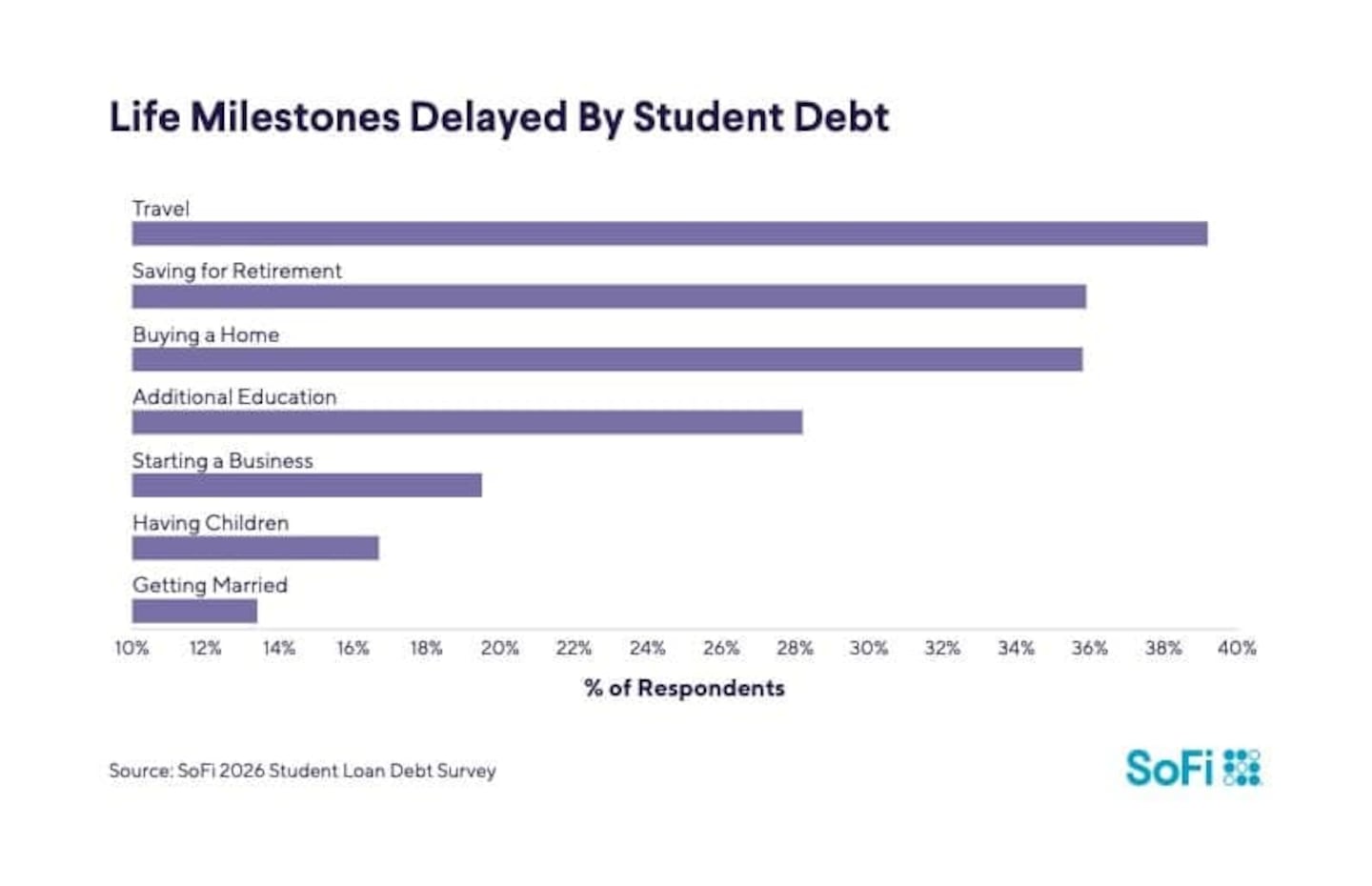
At every age and stage, student debt has a substantial influence on decision-making. Whether survey respondents were thinking about traveling, having kids, or saving for retirement, their loans are on their minds.
Travel is a luxury for many people, but it may be especially out of reach for some student loan borrowers: 39.2% of respondents indicated they have delayed traveling due to their debt. It’s also fairly common to delay saving for retirement, as 35.9% of survey respondents have done.
SoFi
Almost as many student loan borrowers, 35.8%, have put off buying a home, while 28.2% have stalled on pursuing additional education. Nearly 1 in 5 respondents (19.5%) said they had delayed starting a business.
A fun vacation or an extra postgrad degree might count as nice-to-haves. But 16.7% of all student loan borrowers surveyed have delayed having children, while 13.4% have delayed getting married.
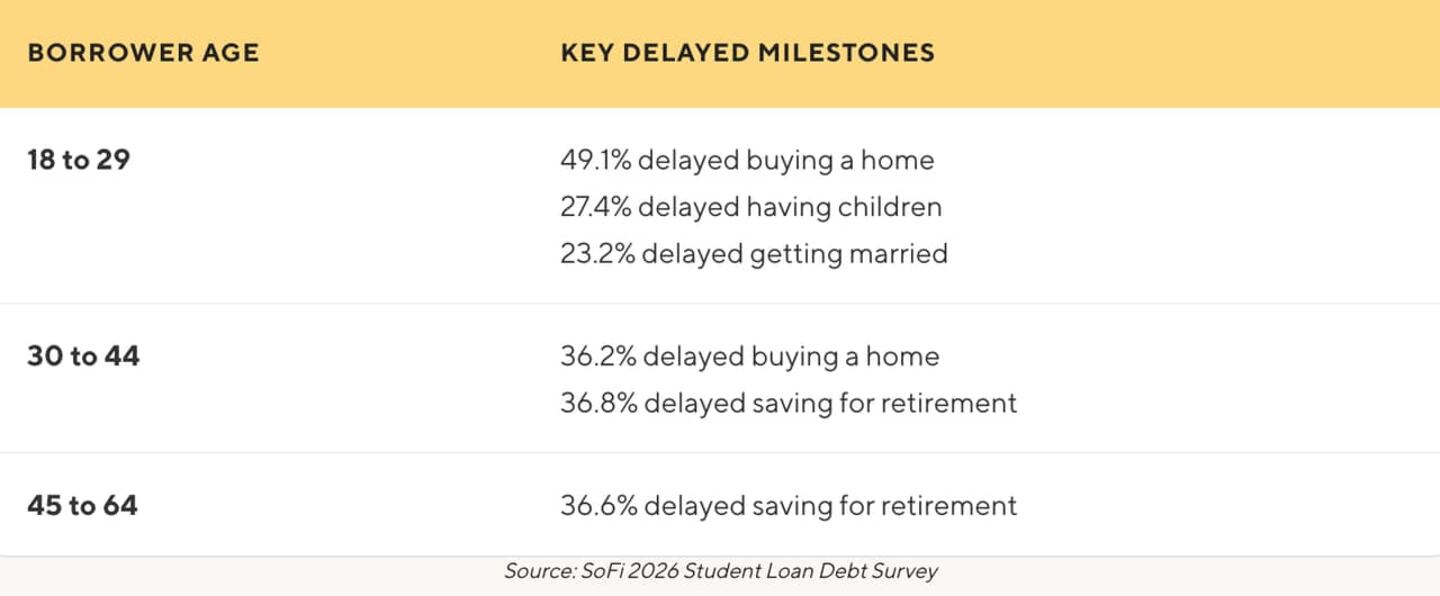
Take a look at how missed milestones shake out according to student loan borrowers’ age:
Pressing “Pause” on Life’s Major Moments
SoFi
How Student Debt Is Shaping Career and Housing Decisions
The student loan debt survey suggests that student loan debt is like an invisible hand directing where people work and live. One of the most significant impacts of student loan debt is on career decisions. Three out of 5 people (60.3%) say the debt has influenced their career or job choices, with men being more likely than women to say they were impacted. More than two-thirds of male borrowers (67.4%) say debt influenced their career versus 53.4% of female borrowers. Survey highlights:
- 23.8% of student loan holders avoided a career they wanted because it didn't pay enough.
- 23.5% took a higher-paying job specifically to manage their debt.
- 30.5% have taken on a second job or side hustle.
- 13% pursued a public-service career with loan-forgiveness benefits, such as working for the U.S. government (including the military), a public school system, or the nonprofit sector.
Where you live is as significant a decision as what you do for work, and here again student-loan debt plays a role. More than half of respondents (55.5%) say debt has affected where they make their home. For 23.1% of student debt holders, that meant staying in their hometown or moving back to their hometown to save money. Almost 1 in 5 (19.1%) reported having moved to a lower cost-of-living place because of debt. And 13.4% decided to forgo moving somewhere they wanted to live because of debt.
The younger the borrower, the more likely they are to find their housing choices driven by debt. More than two-thirds (67%) of borrowers ages 18 to 29 say debt affected where they chose to live. Sixty percent of those ages 30 to 44 felt similarly, while 44.4% of those over age 45 felt that way. The fact that more than 40% of debt holders over age 45 found the long shadow of debt influencing their location shows the powerful hold this debt maintains over time.
What Sacrifices Are Borrowers Making Day to Day?
The home and workplace are by no means the only spheres influenced by student loan debt. Borrowers also mentioned other ways that owing on student loans had changed their lives.
- 44.9% have cut back on dining out or entertainment to keep up with payments.
- 37.9% have reduced or eliminated vacation spending.
- 31.4% have reduced retirement contributions.
- 27.8% have avoided or delayed purchasing a car.
- 20.8% have moved in with family or a roommate to reduce costs.
Perhaps one of the most disturbing facts is that almost 1 in 4 student loan borrowers (23.4%) have put off medical or dental care because of their debt.
Student loan debt holders are not only having less fun — eating out less and skipping vacations — but are also risking their long-term health and financial security by skipping retirement contributions and medical care.
How Borrowers Are Managing Repayment
A significant portion of student loan borrowers are not keeping up with payments, and many are struggling to see an end to their debt. Slightly more than half of borrowers (52.2%) are actively making payments. But more than a third of student loan borrowers (34.3%) have loans in default, forbearance, or deferment. About 1 in 5 student loan borrowers (22%) surveyed were managing payments in an income-driven repayment plan and were likely to be impacted by student loan repayment plan changes and the end of the SAVE plan.
Missed payments are common for the student loan borrowers surveyed. Just over 59% of all borrowers had missed at least one payment, and 29% — more than 1 in 4 — had missed payments multiple times.
Borrowers with both federal and private loans were more likely than those with only federal loans to say they had missed payments (69.1% vs. 57.9%). Among borrowers with only private student loans, 49.7% had missed payments.
More than two-thirds of borrowers earning under $50,000 a year (67%) had missed a payment on their student loans, versus 57.3% of borrowers earning $50,001 to $99,999. While it may not be surprising that those earning lower incomes were most likely to have missed payments, it’s eye-opening that fully 51.3% of borrowers earning over $100,000 a year had also missed payments.
All this adds up to a disturbing scenario for student loan borrowers in 2026. The survey showed that only 26.7% of borrowers feel very confident they can pay off their loans. Another 29.3% are on shaky ground, feeling “not confident” or “not very confident” that they can pay off their debt. And more than 1 in 5 student loan borrowers (21.7%) say they expect it to take over 10 years to fully pay off their loans — or that they may never pay them off.
SoFi
What Is SAVE Plan Uncertainty Doing to Borrowers?
Respondents were surveyed at a time when student loan repayment plan changes were in motion as a result of the One Big Beautiful Bill Act (OBBBA) of 2025. The legislation resulted in a consolidation of repayment plans, meaning many borrowers are facing a 2028 phase-out date for income-driven plans, including the popular SAVE plan. Borrower advocates warn that many borrowers would end up in debt for longer and pay more interest overall.
The uncertainty was likely creating added stress for borrowers in the student loan debt survey, 27.7% of whom were enrolled in the SAVE Plan. Indeed, 15.2% had been placed in forbearance due to the SAVE plan status, as protests against the ending of the plan wound their way through the court system.
In late March 2026, following a court battle, 7.5 million SAVE borrowers began receiving notice that they would need to switch to another repayment plan by July 1, 2026 (with a 90-day grace period) or risk being placed in a repayment plan automatically.
In the student loan borrower survey, 30.1% of respondents said that SAVE uncertainty has caused them financial stress or anxiety. Interestingly, this was slightly more than the number of respondents who actually had SAVE loans, indicating that confusion about SAVE may have spilled over into the general population of loan holders. More than a quarter of respondents (25.3%) said SAVE uncertainty affected their ability to plan for other financial goals, and 22.9% said it made them lose trust in federal student loan programs.
Was the Debt Worth It? What Borrowers Say in Hindsight.
Is having a student loan just a pothole on life’s financial road, or is it more like a giant sinkhole that sucks you in? The survey shows that most borrowers (59.1%) say their education was worth the student-loan-related headaches and sacrifices overall. But only 1 in 5 (21%) say their investment in education has paid off financially.
A far larger group, 38.1%, say that the educational experience was worth it “personally but not financially.” For many borrowers, the experience of a college or graduate education — meeting friends, making professional connections, experiencing life in a different place, and entertaining new ideas — was worth the student loan debt even if it didn’t positively impact their earnings.
More than 1 in 5 student loan debt holders (21.9%) say taking on the debt was not worth it at all.
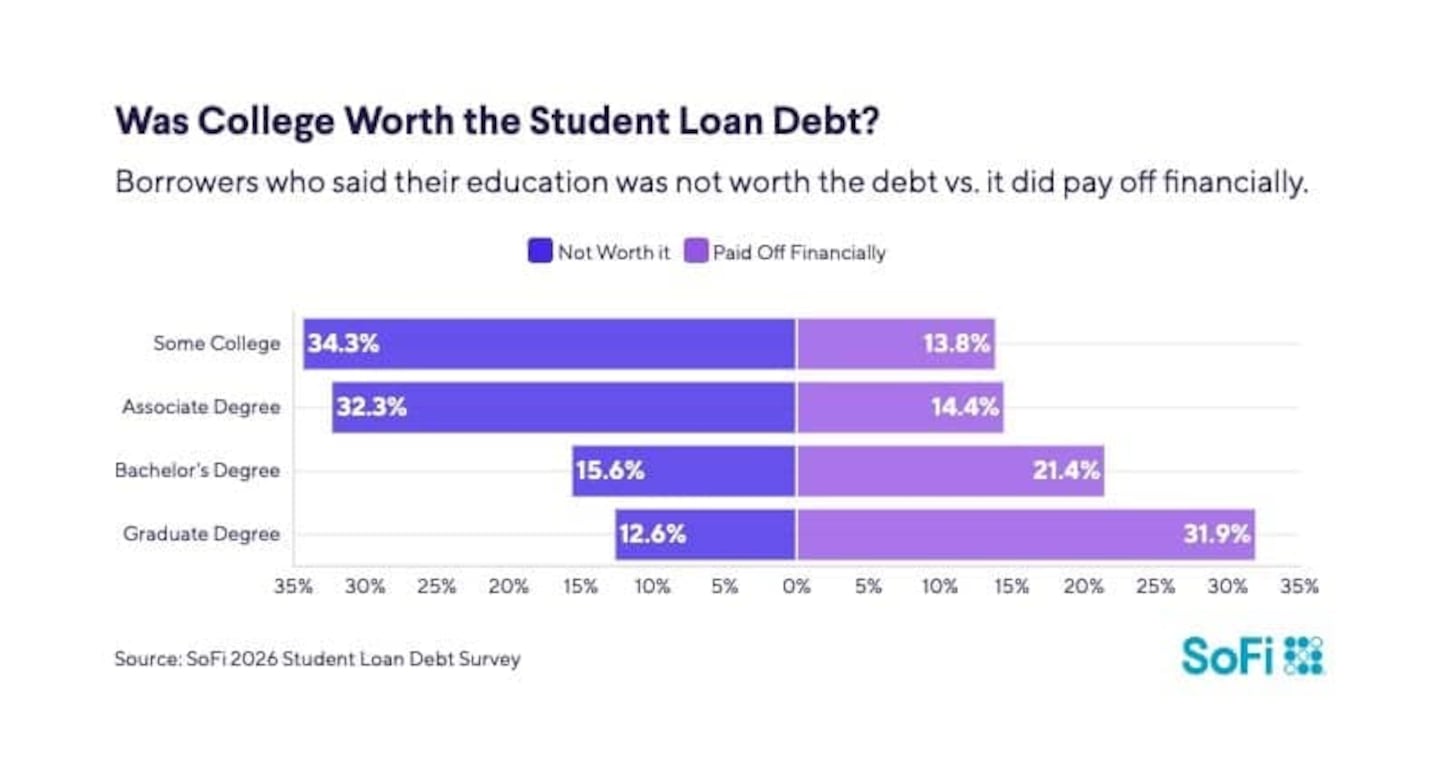
Most borrowers don't regret getting an education. They do, however, often regret how they borrowed money to fund it. These feelings differ based on education level, with those achieving the highest levels of education feeling most positive about their loans, as the chart below shows. The most disappointed borrowers were those who did not complete a college degree, an experience that is unfortunately common: Research from the National Center for Education Statistics shows that 39% of first-time, full-time bachelor's degree students do not complete their degree program within eight years.
SoFi
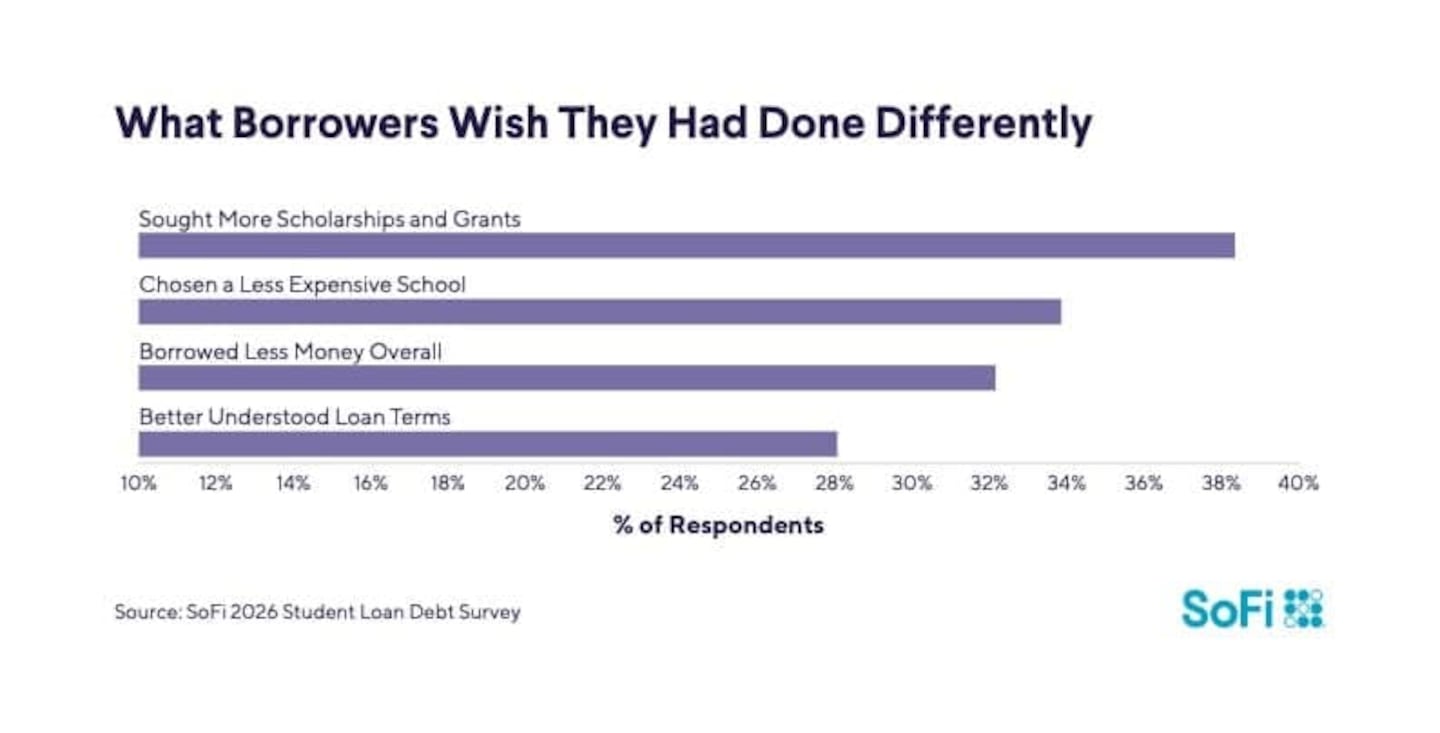
If borrowers could pass on some wisdom to their younger siblings, the tips for a more successful degree-funding experience would look like this:
Apply for free money. A full 38.4% of student loan holders would have sought out more scholarships and grants.
Pick a cheaper place. A third of respondents (33.9%) would have chosen a less expensive school.
Just borrow less. Almost a third of those surveyed (32.2%) would have found a way to borrow less money overall.
Educate yourself about financing. Of those surveyed, 28.1% would have sought to better understand their loan terms better before borrowing, and 37.7% say their college did not adequately prepare them to manage their loans, indicating it's on the shoulders of students to seek information about this issue.
Could Refinancing Help? What Borrowers Say.
For many borrowers, student loan refinancing is a pathway to reduce their interest costs and ensure better compliance with loan payments — not to mention relieve some anxiety about student loan debt. In fact, 62.2% of student loan borrowers in the survey had refinanced or considered refinancing their student loans. Just over a fifth (20.8%) had actually refinanced, and the rest (41.5%) were still considering the idea but had not yet acted.
The quest for a better interest rate on student loans was the primary motivator for refinancing. Among those who had refinanced their loans, 32.2% did it for a lower interest rate, 28.2% to lower monthly payments, and 27.5% to consolidate loans. Of note: A lower monthly payment sometimes results from a lower interest rate. But borrowers can also achieve a lower monthly payment by refinancing to extend the number of years they have to repay their loan. This often results in paying more total interest over the life of the loan.
Many borrowers had refinanced to consolidate federal and private loans into one new loan with a single payment. More than 1 in 4 refinancing borrowers (27.3%) used that strategy, while 20.7% refinanced only private loans and 17.4% refinanced only federal ones.
A significant portion of borrowers in the student loan debt survey, 19.1%, say they don’t know enough about refinancing to consider it. “While refinancing federal student loans is a complex decision right now, it might be helpful to explore if there are ways to pay down your private loans more efficiently,” explained Brian Walsh, CFP, head of advice & planning at SoFi.
A substantial portion of borrowers, 41.9%, believed a lower interest rate through refinancing would most help them pay off debt faster. But borrowers have ideas for improving the student loan repayment experience, and everyone — policymakers, employers, and loan program managers — would be wise to heed their asks:
What Would Help Borrowers Manage Debt Better?
- 39.3% want clearer information about forgiveness and assistance programs.
- 35% want an income-driven repayment plan.
- 33% want employer student loan repayment assistance.
- 30.4% want better tools to track and manage repayment.
What SoFi’s Findings Suggest About the State of Student Debt in America
A peek into the psyches of America's student-loan borrowers reveals the life-altering power of student loan debt. SoFi's survey, which found more than a third of debt holders saying their debt has left them feeling "behind" compared to their peers, suggests that many of the country's current trends may have student loan debt as an underpinning. Student loan debt can be a contributing factor in the nation's drop in domestic partnership and family building rates, the all-time-high age of first-time homebuyers, perhaps even some portion of the nation's mental health spiral.
Student loan debt can be seen as a silent market force, with particularly acute effects for the youngest borrowers who are postponing life milestones in significant numbers. Lower-income borrowers face the greatest challenges.
Confusion and decision paralysis surrounding the legal fight over the SAVE plan and its ultimate termination are likely only adding to the stress borrowers feel around student loan debt. Those with private student loans, however, are also experiencing challenges. Refinancing is one possible pathway to more control over student loan debt, but almost 1 in 5 borrowers don’t feel they know enough about this option yet.
The Takeaway: Student Debt Is About More Than Money
Reaching new educational heights can be exciting, and during the enrollment process, a student loan may feel like just another box to check on a to-do list. But the far-reaching and lingering effects of student loan debt revealed in this survey suggest that borrowers would be wise to consider repayment plans before borrowing.
It’s also a good idea to review your progress toward repayment at regular intervals once you have a student loan. Borrowing isn’t a “set-it-and-forget-it” situation. Understand all your options for repayment, including refinancing if the situation warrants it.
If you’re looking to lower your monthly student loan payment, refinancing may be one way to do it — by extending your loan term, getting a lower interest rate than what you currently have, or both. (Please note that refinancing federal loans makes them ineligible for federal forgiveness and protections. Also, lengthening your loan term may mean paying more in interest over the life of the loan.)
For the 2026-2027 school year, the federal student loan interest rate is 6.52% for Direct Subsidized and Unsubsidized Loans for undergraduates, 8.07% for Direct Unsubsidized Loans for graduate and professional students, and 9.07% for Direct PLUS loans for parents and graduate or professional students.
This story was produced by SoFi and reviewed and distributed by Stacker.


