

For years, the common understanding in the rent vs. buy debate was that buying was "building wealth." Renting was "throwing money away." In 2026, that script no longer matches the numbers.
Mortgage rates sit near 6.6%. The median home costs more than $400,000. And on a monthly basis, renting now costs less than buying in all 50 of the largest U.S. metros, per a March 2026 analysis from Realtor.com.
But a lower monthly payment is just one part of the buy-versus-rent equation. The money you save when you rent can be used for a bigger down payment, an investment fund, or building a safety net that will help fund your next step. As Domain Money explains below, the important question to ask yourself is which path best advances your total financial picture.
What the numbers say in 2026
Early in 2026, financial forecasters predicted rate cuts, and the average 30-year fixed mortgage interest rate briefly fell below 6% in late February, the lowest rates in almost three years. Since then, geopolitical tensions and stubborn inflation have changed the outlook substantially.
As of today, the average 30-year fixed-interest mortgage interest rate is at 6.6%, and the Fed's own projections indicate a possible rate hike by the end of the year. This is a very sharp turn from the projected cuts earlier this spring.
Some notable points of the current housing market:
- Home prices have stayed high. Median new homes are priced at approximately $424,900, per Reuters, which is flat year-over-year. On a longer time horizon, home prices have increased by 54% from 2020 and currently sit at nearly five times the median income, far exceeding the three times ratio of the 1990s.
- The cost of entry almost doubled. The amount of money required to purchase a median-priced home increased from approximately $66,000 in 2020 to greater than $120,000 today. The monthly payment on that same home has similarly increased from approximately $1,700 per month in early 2020 to an approximate $3,100 per month.
- Demand declined. New home sales decreased 7.3% in May, Reuters reported, marking a second consecutive decrease. Current inventory levels would take 10.3 months to sell at this rate, the highest level since 2009.
Financially, homes are a harder sell than they have been in recent memory—both literally and figuratively. But that isn’t the whole story.
Why renting is cheaper than buying in all 50 major US metropolitan areas
The March 2026 analysis from Realtor.com determined that renting a starter home was less expensive than buying one in every single one of the 50 largest metropolitan areas with an average monthly savings of approximately $920, or approximately 55% less expensive.
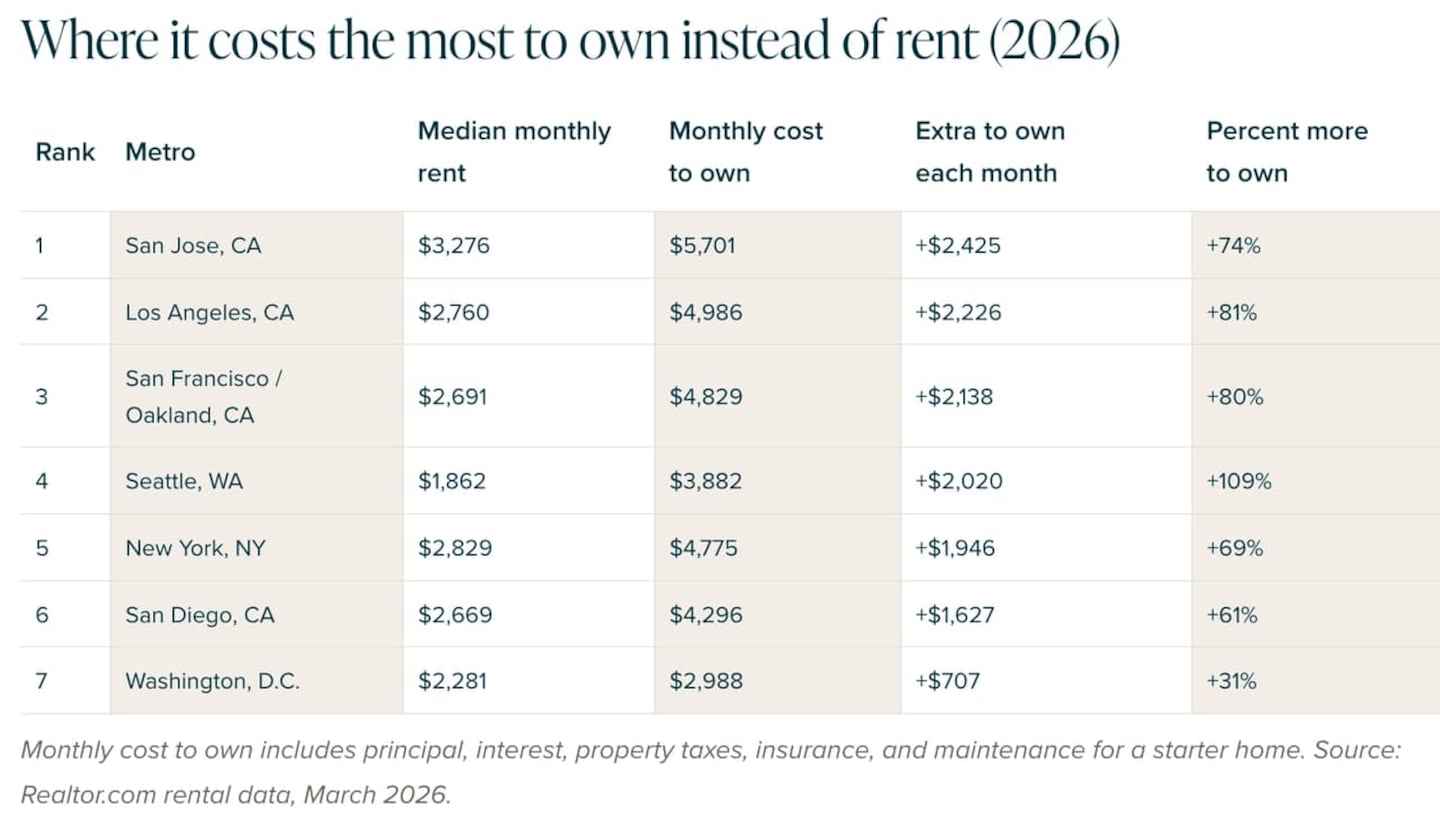
The difference ranged from $64 per month in Pittsburgh to $2,425 per month in San Jose.
So why are there sometimes headlines saying buying still wins in different cities? It’s simply a matter of what you include in the comparison.
Only compare the mortgage principal and interest and buying appears competitive in many markets. But the true cost of homeownership includes property taxes, homeowner insurance, maintenance and HOA fees, and once these numbers are included, the picture changes. Getting this full picture can change the monthly cost of a home by 30% or more.
When you make a true cost comparison for owning versus renting, the results show monthly comparisons favor renting in all 50 markets, and the differences are greatest in the high-cost-of-living areas where home values have outpaced local rents.
Domain Money
In plain English, that means owning a starter home is twice as expensive as renting one in Seattle, and it costs over $2,400 per month more than renting one in San Jose. Those are the markets where the financial advantage of renting is the strongest and where dollars at risk are greatest.
However, in some localities this trend has actually reversed. According to Realtor.com, while the national rent figure posted its 34th straight month of year-over-year decline in May 2026, falling to a median of $1,686, several of the highest cost-of-living cities moved the other way: Rents rose year over year in San Francisco, San Jose, and New York.
That means renters in these cities are not seeing any relief. The buy premium stays large, and rent is firm or climbing. The spread also tells you something a single data point can’t: Two people with identical budgets can reach opposite answers depending on the city.
Calculate your homebuying break-even point like a financial advisor
Beyond your monthly payment, there are additional costs to consider with the complex financial purchase of buying a home.
There are some front-end expenses like closing costs that can range anywhere from 2%-5% of the total price of the house. Selling and buying also come with transaction costs; following recent industry shifts, agent commissions are highly negotiable, but buyers are now frequently responsible for covering their own agent's fees out of pocket. Therefore, to make home buying financially sound, you should have enough years in the home to absorb these upfront and backend costs and create equity.
Here is a rough rule-of-thumb for planning.
Less than 3 years: Generally, renting is likely the better deal. The transaction costs alone typically consume most of the home equity gains.
3 to 5 years: It depends on your location and situation. Crunch the actual numbers.
More than 5 years: Owning starts gaining ground as you begin to create equity in the home and weather the ups and downs in the housing market.
Today, appreciation forecasts are close to 1% in many markets. Low appreciation means that the majority of your equity comes from paying off your loan balance, rather than from increasing value; if your area falls into this category, it will mean extending the timeline necessary to reach a breakeven point.
As a simple example, consider a $500,000 home with a 20% down payment at a 6.5% interest rate and total monthly costs of $3,200. A comparable rental would run approximately $2,300. This represents a monthly savings of $900 for the renter.
However, with appreciation at 1%, it could take longer than 10 years to reach a breakeven point. With appreciation at 3%, it could only take six or seven years.
Another way to quickly assess whether buying or renting is a better choice is to use the price-to-rent ratio. Price-to-rent ratio equals the home price divided by the annual rent for a similar property. If this ratio comes out to under 15, that favors buying. Over 20 generally favors renting. Between 15 and 20, personal factors are going to come into play.
The "waiting for rates to go down" trap
According to Bank of America's 2026 Homebuyer Insights Report, nearly 71% of consumers believe mortgage rates will decline and are waiting for lower rates to make a home purchase. But the Federal Reserve's current outlook may be headed in the opposite direction, meaning homebuyers could see a long wait before getting a break on interest rates.
When rates do fall, there’s a second factor at play: When interest rates decrease, more individuals enter the housing market seeking homes, and rising demand often causes prices high enough to offset any monthly savings achieved by purchasing a home. Unfortunately, you’re not the only person waiting with cash on the sidelines for an interest rate drop.
Rather than waiting for better economic conditions, base your decision on present-day numbers and your individualized timeline. You cannot control how the market behaves, but you can understand your own financial outlook.
Signs buying might make sense for you
For many people, renting will make more sense than buying in the current market. However, some people might be in a better or more optimal position to buy. Some reasons include:
You plan to build a life in your next house. Equity grows significantly over the span of seven to 10 or more years, allowing sufficient time for compounding beyond transaction costs.
You would value having forced monthly savings. While you're paying your mortgage, that money goes to home equity, making a certain amount of wealth building automatic. However, this value is highly illiquid.
You reside in one of several markets that is closer to the breakeven point. There are few cities across America where buying could potentially become less expensive than renting within the next few years.
You'll get value from the tax benefits. There are tax benefits available to homeowners including deducting mortgage interest and property taxes. However, many people still won't beat the standard deductible, making these benefits null.
You highly value stability in your life. The qualitative elements of homeownership, including designing a space without the restriction of a landlord and building long-term relationships in your community, goes beyond what a calculator can estimate.
How renting can build wealth
Renting is not just waiting for the opportunity to buy. It can be a viable wealth creation vehicle if you apply the savings towards creating a down-payment fund or diversifying investments.
If the average expected home appreciation is 1%, all a renter has to do is beat that in a diversified investment portfolio in order to stand a strong chance of coming out ahead. The S&P 500's average return since its inception in 1957 has been about 10%, giving a renter a potential 9% alpha over homebuying, without the friction of real estate transactions.
A larger down payment or buying points on your interest rate can go far when it comes to lowering your monthly payment, making homebuying more affordable and costing less in interest in the long run.
The honest answer: It depends on you
Renting versus buying in 2026 does not have a single answer. It has your personal answer.
It depends on your timeline, your city, your cash position, your equity compensation, your tax picture, and what you want your money to do next. Looking at broader trends can be a useful signal, but there are heavily weighted personal factors that you can’t ignore. That includes the specific area you’re buying in, the opportunity cost for your capital, and the tradeoffs that live inside your full financial plan.
That is the kind of question a financial planning professional can help you work through against your own numbers.
Domain Money Advisors LLC is a registered investment adviser with the SEC. Registration does not imply a certain level of skill or training. See full disclosures at https://www.domainmoney.com/legal.
This story was produced by Domain Money and reviewed and distributed by Stacker.


