

You and your friend may be paying different prices for the same thing. Here's how companies make that happen
A few months ago, a social media post went viral. It showed a screenshot of the Uber app open on two phones. Same location, same destination, same time, but different prices. The caption claimed Uber charged you more when your phone battery was low.
A lot of people thought it was a conspiracy theory. Some said it was fake. Uber denied it.
Perhaps the most interesting part of the story is what Keith Chen, at the time Uber’s own head of economic research, said on NPR back in 2016.
“One of the strongest predictors of whether you’re going to be sensitive to surge is how much battery you have left on your phone,” Chen said.
Uber’s own researcher admitted that your battery level is one of the strongest predictors of how much you’re willing to pay. At the time, he said they weren’t using it to raise prices, but they had the data, and they knew exactly what it meant.
Then in 2023, a Belgian newspaper ran a study in Brussels. Two phones, same pickup, same destination, same time. The phone with 12% battery was charged 6% more than the phone at 84%. Uber denied it again.
But here’s what you can’t ignore. California introduced a bill specifically to ban rideshare companies from using phone battery data to set prices. You don’t introduce legislation against things that aren’t happening.
It's called surveillance pricing. Below, CreditNinja explains what you need to know about it, and what you can do to protect yourself and your wallet.
What Is Surveillance Pricing?
Right now, companies are charging you more than the person standing next to you for the exact same thing. Not because of a glitch but on purpose. Using your data to find the most they can take before you leave.
And it’s completely legal.
In July of 2024, the Federal Trade Commission launched a formal investigation into surveillance pricing, also known as dynamic pricing.
Companies monitor your personal data (your location, your browsing history, your purchase history) and use it to charge you specifically. It’s not a market price or a sales price, but the maximum they think you’ll pay before you walk away.
Harvard Law Today even wrote an article in August of 2025 titled “The Algorithm Thinks You’re Rich. Prepare to Pay More for That Flight” in response to Delta telling shareholders that now they’re not just using customer data, but also using AI to make it even more profitable.
A year before that article came out, the FTC issued orders to eight companies like MasterCard, JPMorgan Chase, Accenture, and McKinsey. What they found was that at least 250 businesses — grocery stores, apparel retailers, health and beauty brands, and home goods stores — had already adopted surveillance pricing strategies.
How Companies Track Your Behavior
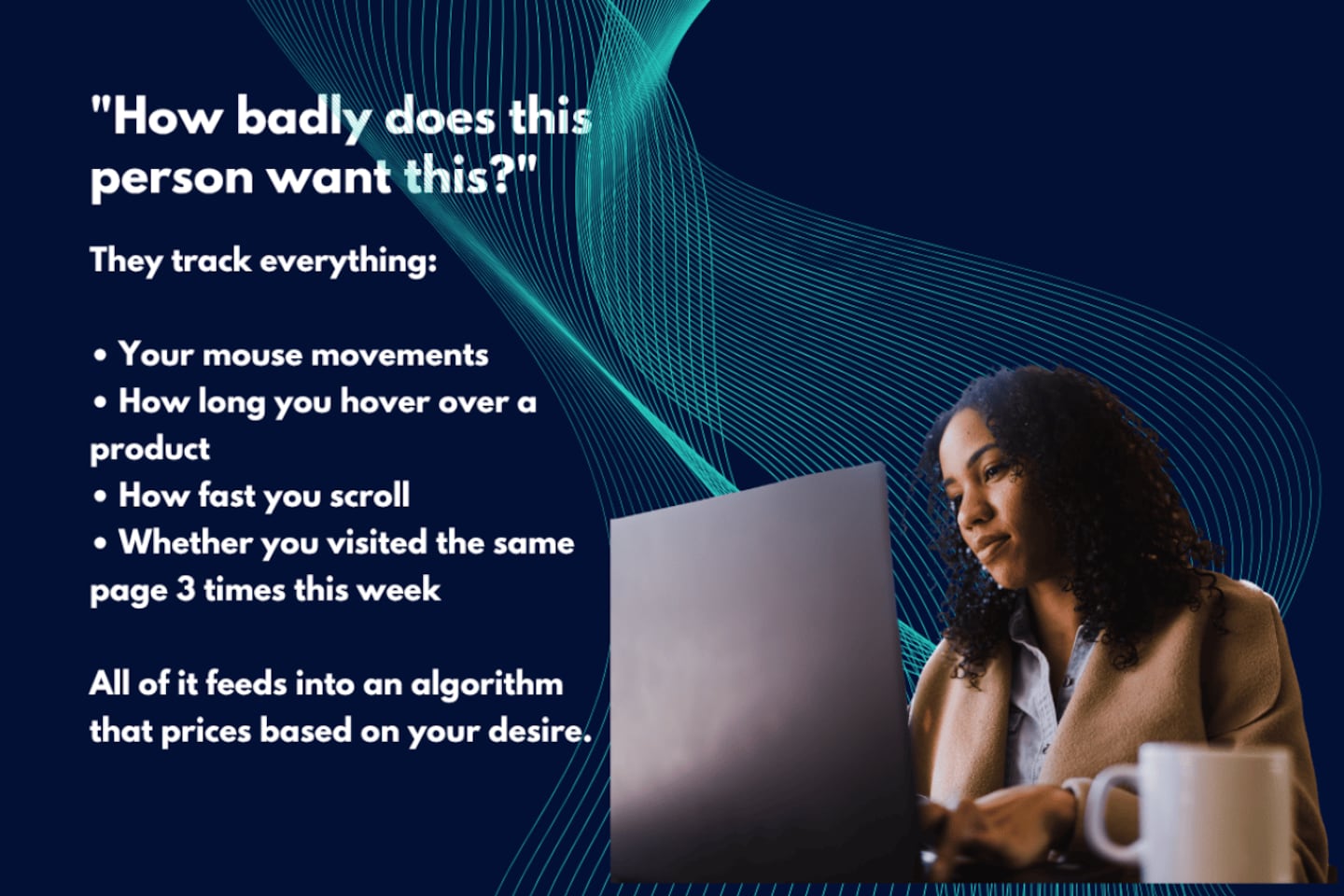
Here’s where it gets uncomfortable. The data these companies collect isn’t just what you buy. It’s how you behave right before you buy: your mouse movements, how long you hover over a product, how fast you’re scrolling, and. Whether you visited the same page three times this week.
All of that feeds into an algorithm trying to answer one question: How badly does this person want this? And then it prices accordingly.
If you revisit an item multiple times, the price goes up. The algorithm reads that as urgency. If you abandon your cart, the price might drop a little bit to pull you back in. But the moment you return and start hovering again, it adjusts. It knows you’re back and it’s watching every move you make.
CreditNinja
Amazon’s Dynamic Pricing
Amazon extensively uses dynamic pricing, and they have algorithms that update product prices sometimes over 2.5 million times a day, so they can stay competitive and maximize profits. These prices fluctuate in real time based on competitor prices, demand trends, inventory levels, and customer behavior.
When You Get Paid, They Know
Here’s where it gets even creepier. Amazon and retailers like them can now detect when you’ve recently been paid. Not because you told them. Because your spending pattern changed.
And when the system decides you have money, you see fewer coupons. Because why give you a discount if the data already says that you’ll buy?
Have you ever noticed that on some Amazon products, there will be a coupon that you can clip and redeem immediately? That’s not a coincidence. Every time you’ve clipped a coupon or signed up for a discount code, you handed them a data point. You told them you respond to deals. You told them exactly how price-sensitive you are.
The Truth About Loyalty Programs
Take Target Circle. Its free reward program offers you personalized coupons and deals. Sounds great, right? But every offer you redeem tells Target exactly what it takes to get you to buy, and they build a model around it. And that model now follows you to every purchase you make with that company.
The coupon wasn’t generous. It was research, and you paid for it later.
Points and rewards aren’t as good as they look, either. Airlines and credit card companies bank on the fact that most rewards go unredeemed or expire before you even use them. You end up spending more chasing points than those points are ever worth.
Before you chase a reward, do the math on what you actually have to spend to earn it. A lot of the time it just doesn’t add up.
Targeting Vulnerable Consumers
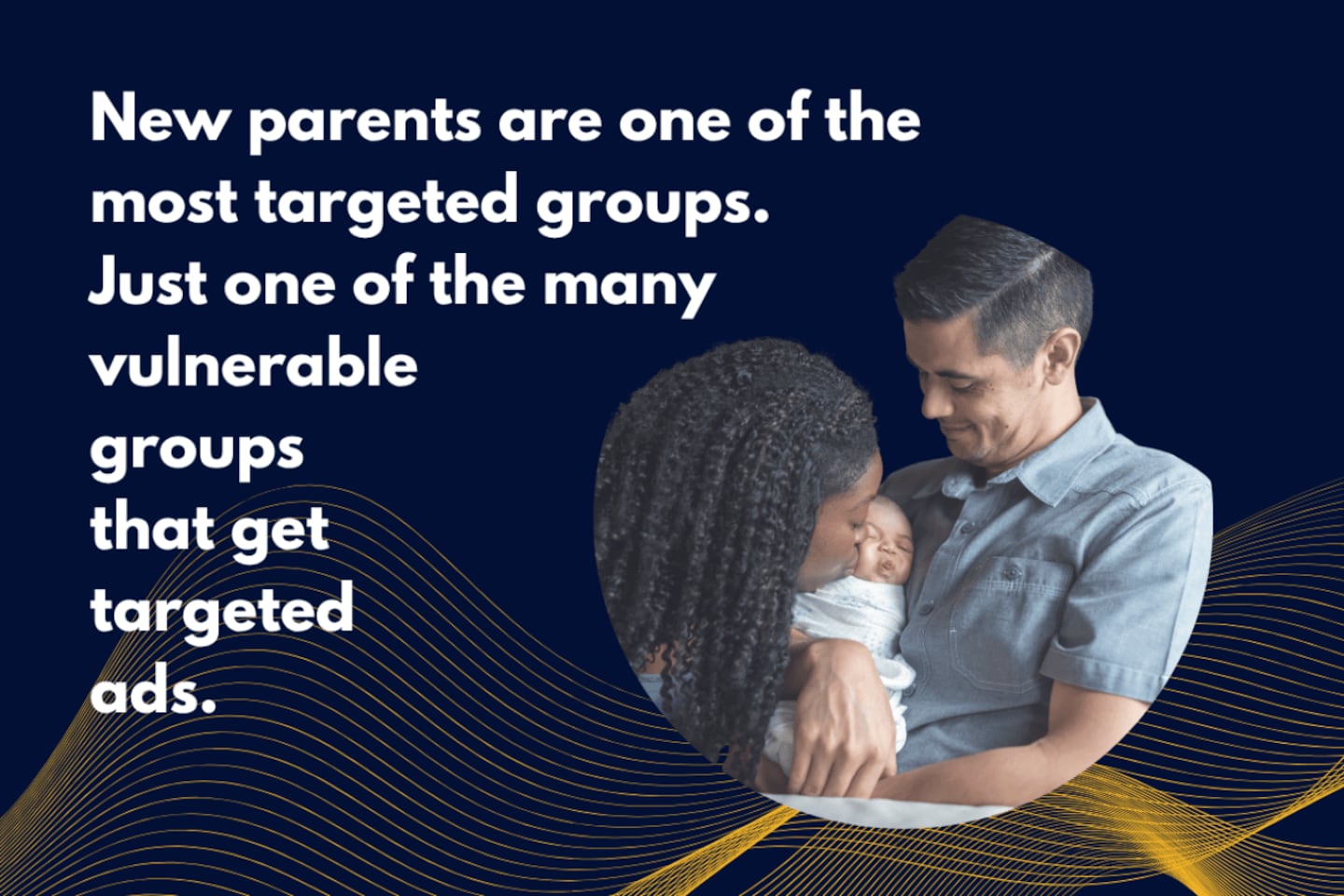
The next way that people are tricked into spending more came from the FTC's own report, showing the next target: new parents.
CreditNinja
The system can detect that you’re a new parent just from your purchase history. It can detect that your baby is sick from your search history. And a company selling baby products can price their items higher for you specifically. Not because you did anything wrong, but because the data says you’re not going to comparison shop. Companies think you’re too tired and scared, and you’re just going to buy it.
This is not a theory or speculation but a documented example in a federal government report.
It’s not just your behavior they’re pricing around. It’s who they think you are.
Real Examples of Price Discrimination
Princeton Review was exposed for charging higher prices for SAT tutoring to customers in ZIP codes with a high percentage of Asian residents. A ProPublica investigation found that Asian Americans were nearly twice as likely to be charged the higher price — not because of intentional targeting, but because Princeton Review’s geographic pricing lines captured many lower-income, heavily Asian neighborhoods like Flushing, Queens, alongside the wealthy areas it intended to target. Different neighborhood, same service, different prices.
Orbitz was caught showing Mac computer users more expensive hotel listings than Windows PC users. Same search, same destination, same dates, just a different device. The company’s own research showed Mac users spend as much as 30% more per night on hotels, so they were shown pricier options first.
Hotel booking platforms were reported to charge users browsing from the San Francisco Bay Area up to $500 more per night than users elsewhere in the country. Same hotel, same rooms, different price based on where your device said you were.
Instacart ran a price-testing program beginning in 2023, allowing retailers to charge different prices to people using the same store on the same platform at the same time. A Consumer Reports investigation found that nearly three out of four grocery items were shown to shoppers at multiple different price points. Instacart ended the program in December 2025 after public backlash, but the fact that it launched at all tells you exactly where this industry wants to go.
None of these companies said they were discriminating. They call it optimization, personalization, and giving you relevant results.
But Lina Khan, the former chair of the FTC, said it plainly: "Given just how much intimate and personal information that digital companies are collecting on us, there's increasingly the possibility of each of us being charged a different price based on what firms know about us."
Airlines and AI Pricing
Airlines have used dynamic pricing for a long time. Flights seem to be consistently changing prices. Booking platforms track your searches through cookies and adjust prices, though claims that simply searching for the same flight twice will raise your price are disputed by researchers and not consistently proven.
Delta Airlines said that roughly 3% of its domestic fare pricing is now determined by AI, and it aimed to grow that to 20% by the end of 2025. This means soon a meaningful portion of what you pay for a flight will be based on what Delta’s algorithm has decided the market will bear.
How to Fight Back Against Surveillance Pricing
Use incognito mode. Start buying flights and doing your online shopping using incognito mode on your browser. Don’t hand the algorithm a search history to work with. If a price feels high, check it from a different device, one that doesn’t carry your shopping history. You might be looking at your price, not the price everyone else sees.
Use a VPN. A virtual private network is a service that creates a secure, private, encrypted tunnel between your device and the internet. When you use it when shopping, it hides your identity and keeps snoopers from seeing what you’re doing online.
Other Marketing Tricks That Cost You Money
Subscription Anchoring
You know when a streaming service shows you three pricing tiers and the middle one just feels obvious? That’s completely intentional. It’s called subscription anchoring.
The cheapest plan is designed to be just frustrating enough that you’ll upgrade and the most expensive plan only exists to make the middle one feel reasonable.
Ask yourself honestly, if the middle price was the only option on the page, would you still pay it? If the answer is no, start with the cheapest plan and see if you actually need more.
TikTok Shop’s Frictionless Spending
TikTok Shop is basically a trap for your wallet. Normally, there’s friction between you and a purchase. You have to open a browser, find the site, type in your card. The pause is enough for your brain to say, “Do I actually need this?”
TikTok removes all of that. You’re watching a live stream. There’s a countdown timer, a flash sale price disappearing in 3 minutes, and before your brain catches up, you’ve already checked out.
Don’t let the algorithm turn your scroll time into a shopping spree.
Fake Countdown Timers
Those countdown timers aren’t just a TikTok thing. “Only two left. Sale ends in 10 minutes.” A lot of that is completely made up. There’s literally no regulation requiring those claims to be true. It’s manufactured scarcity designed to stop you from comparison shopping.
Just pause, close the tab. If it’s still there tomorrow (and it usually is), you’ll have your answer.
Free Trials That Aren’t Free
Free trials that require your card are designed around one thing: that you’ll forget to cancel. The reminder email, if it even comes, usually shows up after the charge has already hit.
The second you sign up for anything, set a calendar reminder and a phone alarm for the day before the trial ends. Don’t rely on their email. They’re not sending it to you to help you.
The Abandoned Cart Discount
When you add things to your cart and then leave without buying, the company sees you’ve abandoned your cart. A few days later, you’ll get an email from them offering you a discount.
So now, if you want something, add it and then leave it until your email comes. Most of the time it does. And this has definitely saved people money.
The Sale That’s Always on Sale
Sites like Wayfair, Amazon, Nasty Gal, Boohoo, PrettyLittleThing always seem to offer items that are somehow 40%, 50%, 60% off.
Turns out the original price was made up. In some cases, illegally made up.
In 2023, Nasty Gal and similar fast fashion brands had to settle and pay out $197 million to customers after a court found their reference prices were never based on actual prior sales. The discount was the price. You were never getting a deal. You were just being made to feel like you were.
Price Anchoring
That’s actually a psychological trick called price anchoring. When you see a crossed-out original price, your brain locks into that number as the reference point. So whatever you’re actually paying feels like a win even when it isn’t.
What to do? Ignore the crossed-out number entirely. The only question worth asking is whether the price you’re paying is worth it to you right now.
Decoy Pricing
Ever noticed how stores put one wildly overpriced item right next to the one they actually want you to buy? The expensive option isn’t there to sell. It’s there to make everything next to it feel like a bargain.
You weren’t saving money. You were being aimed.
Always look up the price somewhere else before assuming something is a good deal just because it’s cheaper than what’s sitting next to it.
Protecting Yourself in the Age of Surveillance Pricing
With the economy right now, every dollar matters. The last thing you want is to hand more of your money to big corporations that are literally running algorithms to take as much from you as possible.
The companies doing this are not going to stop. They’re going to get better at it. The only real protection is knowing it exists, knowing how it works, and doing what you can. Use incognito mode when shopping. Use a VPN to hide your location and identity. Set reminders before free trials end. Abandon your cart and wait for discount emails. Ignore crossed-out prices and decoy pricing. Compare prices across multiple devices and platforms. Question whether you’d pay the “sale” price if it were the only option.
They already know a lot about you. Now you know something about them.
This story was produced by CreditNinja and reviewed and distributed by Stacker.


